|
Catterline has long been associated with the arts and has been known as "the artists village" for many years. Artists, poets and musicians have over the years drawn inspiration from the dramatic seascape and idyllic seclusion offered by Catterline and the surrounding area.
Most famously, Joan Eardley lived in the village producing her most highly acclaimed work.
The Creel Inn hopes to reflect this and features local artists, past and present. We are currently working to develop this further, utilising our walls as a canvas promoting artists whilst enhancing the visitor's experience.
Extracts from: Secret of Survival at Catterline - By Cuthbert Graham
To see, as one does in Braeside, the works of the Catterline artists hanging side by side is a revelation. They glow with a sombre yet fiery beauty. This of course, was the angle of vision that Joan Eardley so powerfully opened up; wintry suns, snow and stormy seas, the oblique lights of the short days. She as gone but she has a potent successor in Lil Neilson who confesses that what inspires her about Catterline above all is "its winter wildness."
Miss Neilson, a native of Fife, and a graduate of the Dundee School of Art, first came to Catterline in 1962 and worked side by side with Joan Eardley when she was at the height of her powers. She now has a cottage-studio in South Cottages, the southern wing of the village which rises up steeply on the high ridge of the cliff on that side of Catterline Bay.
She has painted the village in all lights but most notably at dusk or under sombre skies when the white line of the houses rides like a glowworm on a dark heaving wave of he grassy clifftop.James Morrison, on the other hand, was particularly interested in the patterns made by steeply draped salmon nets, he contours of the fishing craft, the long linear magic of the furrows on the good land which Lewis Grassic Gibbon immortalised in "Sunset Song."
Mrs Annette Stephen, in her colourful retreat at the Old Watch House, produced strong and vivid watercolours often with a maritime theme. She has done some works as a result of a recent visit to Shetland where just as in Catterline itself, man lives very close to the sea-as at Lodberries of Lerwick. Where the old houses dip their feet in the water.
But the secret of Catterline as a milieu for the artist seems to consist in this that nature in all her moods is ever present and familiar. The sense of alienation imposed on man by an artificial urban environment is a thousand miles away.
Joan Eardley
A WOMAN visiting a dentist in Glasgow's east end seemed to be having difficulty keeping still. She kept peering at something in the far corner of the surgery. Eventually the dentist asked what she was looking at. She indicated a small reproduction of a Joan Eardley painting, one of her famous studies of Glasgow urchins, on the wall. Not having marked this patient down as an art lover, the dentist asked her if she was familiar with Eardley's work. Oh yes, she replied, but she didn't know that it was possible to buy such a nice framed print. She just had a copy that she had cut out of the Evening Times.
The painting was of the woman and her sister, yellow-haired, chewing the piece of string Eardley gave little ones to keep them occupied as she sketched.
In her short life, Eardley painted many such children in all their snotty-nosed glory. Later, as her preoccupations became less urban and she spent more time in the north-eastern fishing village of Catterline, she spent more time on landscapes, seascapes and the dramatic weather. When she died of breast cancer, aged 42, she was just starting to be recognised outside Scotland and had, finally, been elected a full member of the Royal Scottish Academy.
Although Eardley is considered a Scottish artist, she was born in Sussex and first studied art at Goldsmith's College, London. But her Scottish mother and grandmother moved to Bearsden in 1940; 19-year-old Joan came with them and she enrolled at Glasgow School of Art. There, she was encouraged by the head of drawing and painting Hugh Crawford. She also met Margot Sandeman, who was to be a life-long friend. The pair holidayed together in Corrie, on the Isle of Arran, where Eardley sketched and painted. One of her first sales was a drawing of a row of Corrie cottages in pen and ink and scumble colour. It was exhibited in Daly's department store and made eight guineas.
Eardley gained her art school diploma in 1944, when the options for women graduates were teaching or war work. A brief stint at Jordanhill teacher training college ruled out the former so Eardley found herself at a boat-building yard, working as a joiner's labourer, painting camouflage patterns onto the hulls of boats.
The war over, Eardley moved to London where she lived in penury, away from her family for the first time. She exhibited when she could, and found London an exciting place, but was affected by bouts of depression which were to dog her for the rest of her life.
During one of these black spells, she applied to Hospitalfield School of Art, a post-graduate summer school in Arbroath. As that was finishing she was awarded two scholarships to travel in Italy and France.
She returned to Glasgow with a sketchbook full of promise. From her first studio, a fourth-floor room in Cochrane Street, she started painting the street scenes and especially children. It was a period of stability: she spent a long summer in France and made friends with another artist, Dorothy Steel. In a new, better studio, above a corner shop at St James's Road, Townhead, she continued to work with the bold children of this teeming tenement neighbourhood. One family, the Samsons, were particular favourites and cross-eyed ginger-haired Pat is visible in several canvases. She also painted her friend Angus Neil in various poses, including naked, asleep, causing a minor sensation when it was exhibited at the Glasgow Institute in 1955.
Eardley discovered Catterline, the village that would be the subject for her finest works, by accident. She fell ill with mumps while in Aberdeen and was taken out for a drive while recuperating. Catterline is an unspoilt, inaccessible little place with an ancient feel, open to the sea, almost hidden from the road. She started spending time there and, with Angus Neil's help, converted a low, two-roomed cottage into a primitive studio.
As the studio in Catterline became more viable, Eardley spent more time there. Her health was never good - she had persistent problems with her back and neck - yet she was out working in even the most ferocious of weathers, a striking figure in her ex-RAF flying suit and clumpy boots, or heavy sweater. The fields, the cattle, the rows of cottages with washing drying and the sea were her subjects and she seemed to find life with no running water and the foul weather challenging, even stimulating.
When she became too unwell to live alone in such conditions, Eardley moved to a more comfortable cottage in the village. She continued working to the end, painting vases of flowers when she could not get outside to sketch landscapes. As the cancer progressed, spreading from her breast to her brain, she was finally getting the recognition that had eluded her for so long. She was, on her deathbed, acknowledged as an important British artist.
Since then, her status has grown. As she is not part of an identifiable group, movement or trend, her work has always stood on its own merit. Many Scottish municipal galleries own Eardleys and the Tate finally bought one, the seascape Salmon Net Posts, in the Eighties. The fact that she was a woman who often painted children possibly allowed the more jaundiced critics to write off her other work. Yet it is these later works, done in Catterline, which qualify her as a painter of world class. One critic, writing in the year of her death, summed her up: "Like Turner, she paints as though the brush were an integral part of her personality ... No slickness here, no tricks, no elegance. Just a trial and error attempt to invent the painterly equivalent of what she so intensely wants to say."
The above was published by The Scotsman newspaper.
The Lady from Catterline
Peter Whitebrook looks at the career of one of Scotland's most outstanding Painters - Joan Eardley
Early August, 1963. A small group of people from Catterline, a tiny fishing village clinging to the Kincardineshire coast, peer through the compartment windows of a train which has stopped at Stonehaven during its journey from Aberdeen. They see, lying on a stretcher and weak with cancer, Joan Eardley, the artist whom critic R. H. Westwater described as "an authentic Star in the sparsely spangled Scottish firmament."
Eardley died at Killearn Hospital, near Glasgow, a few days later on August 16. She was 42. Her ashes were scattered across the rock-strewn Catterline beach beneath the cottage where she lived and worked with formidable passion and where Cider With Rosie, Laurie Lee's Cotswold novel, was read to her during her final days when she was too ill to paint.
Joan Eardley produced two major series of paintings, Glasgow slum streets and urchins and Catterline land and seascapes. To both she brought a documentary and painterly vision rare in any art, almost unique in Scottish. Although the Glasgow pictures are criticised as sentimental, her Catterline work, resonant in Symphonic power, is lauded by young painters to whom she is an under-rated but vital exponent of a Scottish Expressionist art tradition that began last century with William MacTaggart.
The Glasgow Streets which Eardley recorded are now demolished, the urchins grown up. But Catterline is almost unchanged. There is some-thing grimly defiant about the place with its broken row of cottages straggling the cliffs like bad teeth in an exposed lower jaw above a bay where the North Sea thrashes the rocks. If you stand where Eardley stood to make paintings of the sea, the cottages or cornfields, either on the shore near the fishermens' bothy or outside the lonely Watch House, and look around you, the precision of her draughtsmanship and sense of colour comes as a shock. Catterline, twenty years after her death, is exactly as she painted it. The residents, from those who remember her as she stood with her easel weighed down with rocks as she painted a storm sea head-on, to the young incomers, all have a love of the woman and her work and it is in memory of her as much as for their own amenity they fight the periodic planning applications that threaten the coastline with bungalows for Aberdonian oil executives.
Eardley was born of middle-class parents at Bailing Hill Farm, Sussex, in May 1921. Her father, Captain William Eardley, stationed at Maryhill Barracks, Glasgow, during the 1914-18 war, had met and married a local girl, Irene Morrison, and the couple travelled south a second daughter being born in 1922. But Eardley's Sussex childhood was short-lived. The farm failed and the family moved to Lincoln.
The young Eardley's talent for art was encouraged and she studied at Goldsmith's Art School until, in 1940, the family moved yet again, to 170 Drymen Road in Glasgow's Bearsden area and Eardley's association with the city and Scotland began. At Glasgow School of Art she earned the praise of her teachers and won a travelling scholarship which she took up after the war, visiting Italy and France where she made draw-ings. of buildings and peasants that have a Van Gogh-like quality in their fluidity of line and shade.
Returning to Glasgow, Eardley taught at evening classes, rented a studio first at 21 Cochrane Road and then another above a scrap metal store at 204 St. James Road, and began to paint the urban scene around her.
Clad in heavy-duty Sweaters and workman's trousers which emphasised her physical strength, she made studies of the crumbling Townhead buildings with their graffiti-covered walls, pushing her easel and paints about the streets in a rusting pram.
In 1955, she was elected Associate of the Royal Scottish Academy, at the time the youngest woman artist admitted, and her highly-coloured paintings, particularly of the Samson boys and their squint-eyed sisters, hanging out of windows or ranged before defaced walls, were being compared to works by Sickert, Sutherland and MacTaggart.
Sentimentality was never a charge to be laid against her land or seascapes. While exhibiting in Aberdeen in 1950. Eardley discovered Catterline during a drive along the coast. Excited by its isolation, purity and immediacy with nature, she bought the Watch House, a dilapidated cottage at the furthest edge of one of the thrusting promontories of cliff. Her future home, Number One Catterline, could be seen directly across the bay.
Although she maintained her studio in Glasgow and continued to paint slum children, Eardley became gradually more involved with Catterline. Her letters described the rugged beauty of the village and the simple way of life. Her colours became richer and her painting more experimental and Expressionist as she responded to the constant climatic changes of Sea, sky and land. She worked with a renewed vigour and moved to Number One, a ramshackle building with no electricity or water supply. She covered the mud floor with ship's matting, made a makeshift living area and spent her days and most of her evenings painting. In the late '5Os she moved again, to Number 18 Catterline, a cottage with better amenities, keeping Number One as a store. She travelled between the village and Glasgow but if a Storm was mounting, friends telephoned her and she immediately returned to the coast to paint.
Her paintings would sometimes be left outside to "weather." Onto others she would stick grasses and seeds in a drive for authenticity. Her later work is more abstract, showing an affinity with Americans such as Pollock and de Kooning rather than Turner in the energy with which the paint is applied. drips from the brushstrokes spattering the rest of the picture. But with this new development came premonitions of disaster.
A cervical slipped disc had been diagnosed in 1957. At times Eardley was forced to wear a special collar and she was obliged to rest frequently. By March 1963, after a bitterly cold winter during which she had worked as hard as she could. cancer had taken hold. She was gravely ill, visiting Aberdeen Hospital for radium treatment and suffering headaches and deteriorating vision. During the Spring, a London exhibition was an enormous critical and financial success while the artist painters, let alone Scottish painters, have succeeded in doing that and I find it astounding, for instance, that not one of her paintings is in the Tate Gallery. For young Scottish artists she is almost a saint.
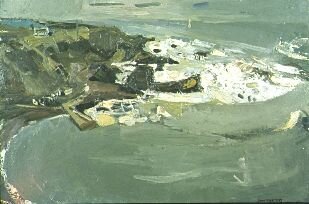
Winter Sea IV by Joan Eardley
|

