

The Beginnings | back to top |
The church of Caterlyn with it's lands.teinds and offerings was granted to Arbroath Abbey by it's founder King William I at, or soon after its foundation in 1178.Around 1206 the apparent owner of the lands of Katerlyn gave two oxgangs of land called RATH in the estate of Catterline. with the use of the mill of Katerlyn to the Abbey. Around 1222-40 he, William, son of Bernard confirmed the earlier gift and also granted 19 acres by the sea called TREGLES with its rights and pertinents. Both gifts were witnessed by the donor's son and heir Bernard (son of William son of Bernard) “within the farm of Tregles".
Around 1211-14 John de Montford granted the abbey lands called GLASKELER which lay between HIS lands of Catterline and the Catterline Burn, with the use of the mill dam of Catterline, with the stipulation that all the men on his half of Catterline called LUNGYRG were to pay their mill dues to the Abbey. Rath was obviously the Reath of Catterline, the high ground south of the village between the Burn and the sea. Tregles and Glaskeler were lost, but Lungyrg could be Lumgair in Dunottar parish. Tregles was arable land near the sea, perhaps an old name for Hilton of Catterline next to Trelong Bay which sounds like the nearest local name.
In 1371 King Robert III granted to Thomas Rait the barony of Uras with its fishing’s (Crawton), also Cloak and Hilton and other lands to the north and: KATERLYN WITH RIGHTS OVER THE HAVEN, OF OLD OWING AND CUSTOMARY but with no mention of fishing’s or a fishertown.
In 1483 Arbroath Abbey leased their lands of the town of KATERLING with the mill to Duncan Spark and his wife for £10 annual rent, with the right to have co-tenants and sub-tenants. In 1526 the Abbey's lands and the mill were leased to Andrew Moncur of Mains (Dundee) and his wife Janet Graham for 19 years for an annual rent of 2 chalders of barley, two chalders of flour and ten multures from the mill. The next lease in 1542 was to David Wood of Craig, near Montrose. He also leased other lands from the Abbey with salmon fishing’s in the South and North Esks and in the Dee at Torry, but no fishing’s are mentioned in connection with Catterlme.
The lands belonging to the Abbey were not necessarily in a compact block, they included the Rath or Reath as described above, the church lands and Glaskeler probably on the west of the burn. 19 acres of Tregles near the sea which may have been part of Hilton next to Trelong Bay, and the mill which probably had some land attached There is not a suggestion that the Abbey owned the haven or fishing’s and in 1371 the haven was attached to another part of the lands of Catterline. However charters of the superiority of the Regality lands of Arbroath of 1608, 1641 and 1662 list Catterline with its HARBOUR AND FISHINGS. The name seems to derive from the P-Celtic or Pictish CATTER, a seat or flat topped ground, and LYNN, a pool or waterfall, so the name spot would seem to be the fall on the Catterline Burn to the north of Mains of Catterline.
The Community In Early Times | back to top |
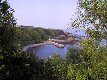
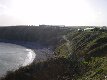
There may have been a small fisher community, from very early times since there is a shingle shore given some protection by a headland to the south and rocks to the north, although northerly and easterly storms can sweep over an underwater reef at the entrance to the haven and push high tides onshore making dangerous conditions to land a boat. At other times it is safe to land and launch small boats and there is room to pull them beyond the highest tides.
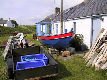
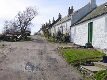
Rights to the haven attached to (Mains of?) Catterline. OF OLD OWING AND CUSTOMARY suggest that a fishing community was well established by 1371 even if no fishing’s are mentioned since no trade is likely at that date. There may only have been a single boat's crew and around half a dozen families before the 18th century. Their cottages were undoubtedly on the site of the present ones in the center of the village on the central part of the ridge separating the burn from the sea, giving a clear view of the haven and out to sea.
There is definite evidence of the "harbour" or exploitation of the haven and fishing’s from 1608 and in 1627 Thomas Watt and John Findlay , dwellers in HEUGHHEAD OF CATTERLINE are recorded. The name Watt was the commonest one at other fishertowns in the parish in the 18th century and Findlay is known later as a fisher surname elsewhere on the coast. In 1642 HEUCHEAD is listed as one of the "little shores for fisher boats" in the Mearns. Gourdon folk in recent times still referred to the Catterline fishers as "Heucheiders", an apt description of their place of residence on the top of a heuch or cliff.
The parish registers, extant from 1730, record many folk with well known local fisher surnames resident in SEATOWN OF CATTERLINE. In 1772 Arbroath Town Council was arranging to pay the removal expenses of a boat's crew of five men and a boy, with their families, from the "Hacterland near Bervie". Four of them bore the peculiar name Bridgefoord which proves beyond doubt that this was a corruption of Catterline. No further mention was made so they may not have moved to Arbroath and the name is not found there.
In 1792 there were two boats at Catterline, each with a crew of six, so there must have been at least 10 or 12 fisher families and a total population of around sixty or more. It was said that the fishers were giving up fishing due to the haddock dearth (1785 - 94), the checking of smuggling by the vigilance of the customs cruisers and the seizing of fishermen by the Press Gangs. So there may have been three boats and crews in 1772 when one was considering emigrating. By 1813 there was only a single boat and crew so the decline noted in 1792 had continued.
The Victorian Boom | back to top |
By 1841, and probably from about 1835 the community had revived, although herring fishing does not seem to have been started until the mid - 1840s. The new statistical account of 1842 says that there were two boats and crews, implying 12 fishermen and boys, but the census of 1841 records 29, so there are more likely to have been five boats. The account also states that the single boat at SheilhiIl was "weakly manned" while the 1841 census records six active fishermen aged 21 to 42 i.e. in their very prime. It adds that there were twenty-odd families resident at Catterline including the Coastguards. The Coastguards were probably established around 1835. The Coastguard houses, a two storied one for the officer, with cottages and an office in similar style to the fisher houses may have been built by the landlord Lord Arbuthnott since this was common practice; only at Auchmithie and Muchalls did the Coastguard themselves build two-story blocks to accommodate a station. There was also an Inn by 1841 and the pier had recently been built in 1842.It seems that the siting of a Coastguard station may have inspired Lord Arbuthnott to rebuild and extend the village from around 1835 to encourage the build-up of the community. There were about 35 inhabited houses in 1841 so it seems that the account, dated 1842, may have been drawn up some years earlier between 1835 and 1841, so the pier may date from that period also, as may the inn. Usan had been entirely rebuilt by it's laird in 1822.
Coal sloops or barks had landed at Catterline and Braidon Bay in summer in the 18th; century lime for the fields was also landed since farm carts had access to both beaches. They came from the Forth or Newcastle area. It was suggested a pier should be built to offer a safe harbour for such coasters of 30 to 40 tons burden, suggesting the encouragement of trade and manufacturing at Catterline. So it appears the pier was built around 1835 - 41. In more recent times a wooden hulled steamer brought in coal once a year up to around 1930.
The pier must also have been useful in enabling the local herring fleet to land. Curers engaged local boats from the early 1840s to land herring at Fraserburgh for a six-week season from mid - July to early September. The largest boats around 1850 were only around 35' overall, ten feet longer than the winter or sma' line boats. By 1855 Catterline had nine boats, three were herring (and great line) boats of about 40 ', four were sma' line boats around 25 'and two were yauls of around 17'.
By 1881 when the industry was at it's peak locally, Catterline had 8 herring boats and 21 boats or yauls. In 1858 six boats were landing herring at Catterline, which became the smallest herring station on the coast compared with Stonehaven where 80 boats were landing and Gourdon with 76, many of them from East Fife. William Stephens the innkeeper was the curer who organised the small-scale herring curing at Catterline. Only three boats were landing at Catterline in 1864. This seems to have ceased by the 1880s or earlier and the local drifters probably landed at Stonehaven, Gourdon and Montrose and possibly further afield. After the mid-1880s most of the smaller places without proper harbours and curing stations dropped out, and by 1900 or so this seems to have been the case at Catterline.
The boats got to be so large and heavy decked, carvel-built and 55 'or over by the 1890s that they were hauled up by a steam traction engine operated by Jackie Barclay into the ground well above highest tides in Trelong Bay and were laid up from early September until about May when they would be launched at the start of the great line deep-water cod fishing followed by the herring season.
The Coastguards involvement in life saving, in co-operation with the local fishers, gradually became a more important part of their function. By the 1870s many places such as Usan and Stranathra (Muchalls) had a rocket life-saving brigade, although there appears to be no evidence for one at Catterline. A cart hauled by the best pair on the nearest farm carried a line, which could be fired by rocket to a grounded ship, a Breeches buoy was rigged up and crews rescued. At West Haven, Carnoustie and Gourdon, a 22 foot surf-boat with six oars, steered by a long sweep at the stern was maintained from 1890 in connection with the Coastguard (The Gourdon one still exists in Steven's fish house) The shed behind the pier once housed the Coastguard's surfboat for inshore rescues. The station must have been one of those closed in 1905.
20th Century Decline | back to top |
Once the large boats were sold off or abandoned around 1900 the fishermen relied on sma' line fishing in winter and creel fishing in summer. Auxiliary paraffin motors were available from 1906 but by 1928 only three of the eight yauls had motors. By the 1940s there was only one yaul out of the eight still in use working with sail, Jack Noble's 'Boy's Delight'. Some had been built before 1914. After the war there were still six or seven motor yauls. The last, worked up to about 1955, were the 'Rose 'and the 'Meanwell ',one 18' the other 19 '.They had both been built at a boatyard at Cowie, and cost £1 per foot! From around 1962 Jim Moir started up again with Jim Stephen and John Watt, but about 1985 he and John Watt ceased line fishing and only do creel fishing in summer now'. Their boat, the 21' A440 'Mascot' is not a true yaul but was a ship's lifeboat from the steamer' Torquay' built in Aberdeen. There are also a few small boats used for pleasure and part-time creel fishers.
Salmon Fishing | back to top |
There were four or five salmon fishers resident in 1841, most with white-fishers surnames There are no early records of salmon fishing in the parish, probably it only started up with the introduction of bag nets shortly before 1840. There are salmon bothies at Sheilhill and Trelong Bay also. The Catterline bothy sits behind the old boat-shed, below the Coastguards watch house. Salmon fishing only took place in summer for about eight months latterly a shorter season; in winter they worked on the farms at tattie-dressing etc. There seems to have been a salmon station right through to 1950 when the fishing ceased. Latterly it was owned by, Johnstone of Montrose.
Dialect | back to top |
Catterline has several native residents unlike the landward area around. There is a slight north intonation compared with Gourdon, but otherwise the vocabulary is similar to the southern Mearns and Angus. Lassie is used in preference to quine and vowel sounds are totally different to the typical North East heard in Stonehaven such as "sneed, meen, speen, sheen". In Catterline, as in Gourdon and places to the south these are "snuid, mum, spuin, shuin". A peculiarity shared with Montrose burgh and all the flshertowns from Usan to Gourdon is the vowel sound found in "doe, toe, yosed" for the English "do, to, used" where inland speakers would say" dac, tae, yaised " Curiously, Catterline is a cultural crossroads between the North, starting at Stonehaven ( or Crawton before 1926 ), and the South. While it is linguistically southern Mearns the system of using three, rather than two sma' lines, and the spiletree to redd them makes it North Eastern in material culture.
Fisher Surnames | back to top |
In 1627 Thomas Watt and John Findlay are recorded as residents of Heughead of Catterline. From 1732 the parish registers record the surname Bridgefoord as predominant in the Seatown of Catterline. The name is recorded up to 1776 but afterwards disappears. It was recorded in Stonehaven in 1637 as Brigfuird and derives from a barony in Dunnottar parish recorded up to the 1720s.
In 1772, of a boat's crew of six considering moving to Arbroath, two were called Alexander and four were Bridgefuird. Other names recorded in the 18th century' were Largie in 1734, Watt in 1750, Cormack in 1755, while women called Bleber and Hampton were married to Bridgefoords. The name Stephen first occurs in 1785 and soon after 1800 when other names from Stonehaven and Cowie appear such as Christie and Freeman. In 1841 about 17 out of 30 heads of families were called Stephens and the vast majority of fishermen were Stephens. In 1881, 14 out of 30 fishermen were Stephens. Other names in the 19th century were Taylor and Davidson and Noble.
Numbers of Boats and Fishers | back to top |
|
YEAR |
Boat |
Fishers |
Type of boats |
|
1772 |
3 |
18 |
23 'boats |
|
1792 |
2 |
12 |
“ |
|
1813 |
1 |
6 |
“ |
|
1841 |
4 or 5 |
29 |
23 - 30 'boats |
|
1855 |
9 |
56 |
3 drifters, 4 boats, 2 yauls |
|
1881 |
29 |
30 |
8 drifters, 12 boats, 9yauls |
|
1928 |
8 |
20 |
yauls - 5 sail, 3 motor |
|
1940 |
8 |
20 |
yauls - 1 sail, 7 motor |
|
1945 |
6 or 7 |
15-16 |
motor yauls - under 20' |
|
1955 |
2 |
8 |
motor yauls - under 20' |
|
1962-90 |
1 |
2 |
Motor yaul – 21’ |
Spellings | back to top |
From
To
Function
Resident
1841
1894
Inn
William Stephen - Fisherman & Curer
1894
1915
Inn
Mrs Eliza McRae - Daughter of William Stephen
1915
1916
Grocers Shop/Inn
Margaret Brodie
1916
1919
Grocers Shop
Margaret Moir
1919
1922
Grocers Shop
Margaret Moir/Jas McBay (Fisherman)
1922
1925
Grocers Shop
James Mason (Salmon Fisherman)
1925
1939
Grocers Shop
James & Lavinia Mason (Salmon Fisherman)
1939
1953
Grocers Shop
Lavinia Mason
1953
1954
Grocers Shop
Alex Cormack
1954
1956
Inn
Alex Cormack - changes back to an Inn
1956
1964
Inn
James D Jack
1964
1969
The Creel Inn
James D Jack - 1st known as the Creel Inn
1969
1974
The Creel Inn
Hugh & Helen Weir
1974
1976
The Creel Inn
Gordon Bruce
1976
1979
The Creel Inn
Gordon & Hazel Bruce
1979
1981
The Creel Inn
J & T Colmar
1981
1985
The Creel Inn
James & Avril Young
1985
1996
The Creel Inn
DM Cargill & Mrs Moira Cook
1996
2002
The Creel Inn
Robert & Jacki Cleaver
2002
>
The Creel Inn
Robert S. Lindsay
| back to top |
1178-98
Caterlyn
C 1200-40
Katerlyn
1371
Katerlyne
1483, 1526
Katirling
1542, 1662
Catterline
1608
Catterling
1627
Heuchead Of Caterline Caterlyne
1641
Caterlyne
1642
“Heaughead” (Of Catterline)
1703
Cartalin
C 1750
Ketterline
1732-1814
Seatown Of Catterline
1772
Hacterland
1774, 1813
Katerline
1822
Katterline
1841 >
Catterline
The name is basically that of an estate. The modern local pronunciation is KE*IRLIN, *being a glottal stop.
If anyone knows the author of this document I would pleased to receive contact details. Until then I would like to express my appreciation for the detailed information contained above.
Any historical information and comments are also very welcome. I will do my best to build this document with any information received.
| back to top |
Catterline (1178 - 1985) | back to top

Smugglers Lugger Captured at Catterline - August 17th 1778
A few months ago a smugglers lugger was taken by one of the excise yachts stationed on the coast and since then has been tied to a tender.
One of our fishing/smuggling cutters chassed her into the harbor of Catterline; where the crew got ashore, being obliged to surrender her to the superior strength of the cutter, which the audacity to cut her out of the harbor and carry her off in triumph.
Gourdon Boat founders - 1890
The fishing boat "Scottish Maid", of Gourdon, has foundered off Catterline, with all hands. Several fishermen, with the aid of a powerful glass, saw her before she sank.
Her crew were:
Gourdon Boat Crew taken prisoner & Boat blown up - 1916
When the fishing boat "Bella" was line fishing off Catterline, she was accosted by a German U Boat and her crew taken on board the submarine.
The "Bella" was blown up by the Germans and her crew taken to Germany, where they remained until the end of hostilities.
Their names were :
Exerts taken from the RNLI book Wild and Rock Shores.
| back to top |
